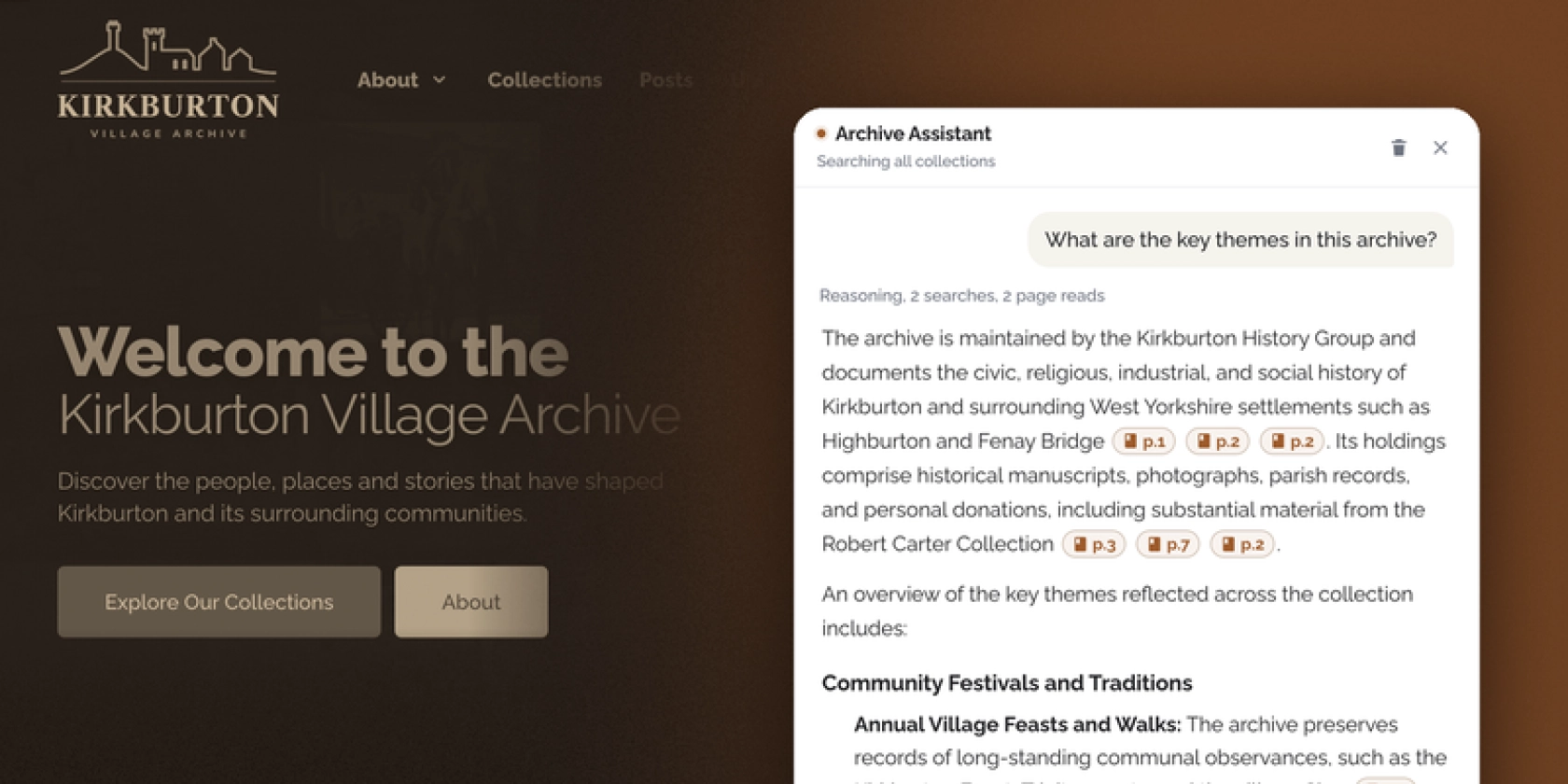
Ask questions of your collection in plain English. Archive Assistance is a conversational AI tool that lets users explore an archive naturally, without needing to know the right keyword, reference number or spelling variation. Rather than searching for a term and hoping it matches the language used by the original cataloguer, users can ask a question as they would ask a person and receive a sourced, accurate answer drawn directly from the collection. Responses are linked back to the original source material, so users can explore further, verify what they have found and cite their sources with confidence.
/ Archive Intelligence
Many organisations hold archive and heritage collections of real beauty and historical importance. Photographs, letters, maps, ledgers, manuscripts and records that deserve to be preserved, published and made accessible to researchers, communities and the public.
But for many collection holders, that ambition runs into a familiar obstacle: cataloguing. Material that is under-catalogued or not catalogued at all cannot easily be searched, shared or understood. And cataloguing takes time, specialist knowledge, consistent standards and resources that many organisations simply do not have. In some cases, the cataloguing backlog becomes a bottleneck that delays an entire project for months or years. In others, it brings progress to a halt altogether.
Archive Intelligence uses AI to help break that bottleneck. Working directly from digitised images, our technology can read, analyse and extract structured information from a wide range of archive material, including handwritten documents, without the need for a separate OCR stage. The result is a detailed, structured first pass of catalogue data that gives your team a valuable head start.
Every piece of information we extract can be traced directly back to the source document, so you always know exactly where it came from.
The aim is not to replace archivists, researchers or collection holders. It is to give them a valuable head start, reducing repetitive manual work and allowing their time and knowledge to be used where it matters most. Clients remain in control. Information can be reviewed, refined and approved before it is published, and users can be directed back to the original source material.
Every collection is different, so the information extracted can be tailored to the client's needs. Clients can choose the data fields that matter to them, such as names, dates, locations, organisations, document types, subjects or collection-specific information. We can work with them to define the required outputs before processing begins.
/ Heritage Digitisation + The Power of AI
/
Auto Title Generation
Give every document a clear, consistent title automatically. For collections where items are untitled, inconsistently described or have never been formally catalogued, Auto Title Generation provides a practical and scalable starting point. Our AI reads each item and generates an accurate, descriptive title based on its content, bringing structure and consistency to collections of any size. Titles can be reviewed and edited by your team before publication, ensuring the final output meets your standards and fits your catalogue conventions.
/
Metadata & Tagging
Turn unstructured archive material into searchable, structured data. Metadata and Tagging allows clients to define the fields that matter most to their collection, whether that is names, dates, locations, organisations, document types, subject tags or something more specific to their holdings. Our AI works through the material systematically, extracting and generating structured data to those specifications. The output can be delivered in formats compatible with your catalogue system, heritage platform or web portal, giving you clean, consistent data that is ready to use and ready to publish.
/
Transcription
Make the written content of your documents readable, searchable and accessible. Our transcription service converts both typed and handwritten material into accurate text, opening up collections to full-text search, research and wider public access. This is particularly valuable for collections where the content of documents is as important as their existence, such as correspondence, diaries, ledgers or administrative records. As with all our AI outputs, transcriptions can be reviewed and approved by your team before use, ensuring accuracy and consistency across the collection.
/ Why choose Us?
It’s a family affair
We’re proud to fly the flag for family-run businesses, and although our team has grown significantly over the last 70 years, we still bring a personal touch to everything we do.
Complete protection
To ensure your materials are safe in our care, we implement strict security measures and undergo regular disaster recovery assessments.
Specialist heritage facilities
The storage, preparation and digitisation of your heritage materials is carried out in our purpose-built single-level, temperature-controlled studio area measuring over 10,000 feet.
Respected and respectful
Our skilled, knowledgeable and experienced handlers and technicians are known for their meticulous handling of heritage materials – treating them with the respect they deserve at all times.
Gentle preservation
We use cutting-edge technology and advanced techniques to provide one of the UK’s most specialist digitisation services for your rare, precious and fragile heritage materials.
Services by us, for you
Our flexible services are fully tailored to ensure organisations meet their key objectives regardless of the type or quantity of materials.
/ Reviews from our Customers
Alison John
Registration Services Manager, Warwickshire County Council
Anne Atherton
Superintendent Registrar, St Helens Registration Service
Microform Imaging have been a great company to work with, delivering excellent service and creating a unique, bespoke partnership.
Dawn Titherington
Superintendent Registrar, Blackpool Council
Gillian Greeson
Superintendent Registrar, Wigan Council
Pat Evans
Superintendent Registrar, The Register Office, Liverpool
Robert Harrison
IT Director and Partner, HGF
Sir Stirling Moss
/ Our Accreditations
/ Frequently asked questions
What is the difference between DIA and DAA?
Document Intelligence Assistance (DIA) uses our own AI models to analyse your documents and organise your collection. It:
Extracts key information from each document, such as people, places, organisations and dates, and adds it as searchable tags.
Categorises documents by type and subject, so the collection can be browsed and filtered in meaningful ways.
Clusters related documents together, bringing out connections and themes across the collection that are hard to spot by hand.
This makes your collection richer, easier to search and quicker to catalogue, and no third-party AI provider is involved.
Document Archive Assistant (DAA), also known as Archive Assistant, is an AI research assistant for your collection. When you ask a question, it works out what you are looking for, searches your archive, and summarises what it finds, with references to the exact documents and pages it used.
It works only with your archive. It does not search the internet or use outside sources to add to its answers.
What happens to my data when AI is used?
DIA and DAA handle data in different ways.
DIA: All processing uses our own in-house AI models. They run on our on-premises servers or, temporarily, on dedicated GPU servers in London hosted by our partner RunPod. Your documents are never sent to a third-party AI provider, and no third party uses your data to train models.
DAA (opt-in only): When you ask a question, DAA finds the most relevant passages in your collection and sends only those text excerpts, never page images or full documents, to an external large language model (LLM) provider, which writes the answer. We use Google's enterprise Gemini service. Under Google's enterprise terms, your data is never used to train or improve their services.
Where is my data processed, and who can access it?
Your data is stored on our own on-premises servers in the UK. Some processing runs temporarily on dedicated GPU servers in London provided by our hosting partner, RunPod. This is used for DIA only, and data is not stored there once processing is complete.
If you opt in to DAA, the text excerpts sent to answer your questions are processed by Google under its enterprise data protection terms.
Within Microform, only specifically authorised employees with a genuine business need can access customer data. This includes support staff where their role requires it. Access:
is limited to the minimum needed for each person's duties
must be approved by the data owner or authorised management
is reviewed regularly and removed when employment or contract work ends
requires multi-factor authentication for privileged access to production systems
Outside Microform, your data is only handled by our hosting partner's servers while DIA processing is running and, if you opt in to DAA, by our LLM provider as described above.
Can OpenAI, ChatGPT or any other third-party AI provider access my documents?
With DIA, no. DIA uses only our own AI models, which run on our servers or on our UK hosting partner's servers. No third-party AI provider is involved.
With DAA, which is opt-in, our LLM provider, Google (enterprise Gemini service), receives only the excerpts needed to answer your question. It never receives your full documents or your full collection, and it cannot use your data for training.
What cybersecurity protections are in place?
We use technical and organisational safeguards to protect customer data, including:
Encryption: Data is encrypted in transit (TLS 1.2 or later) and at rest (AES-256), on both our on-premises systems and cloud services.
Independent audits and testing: Regular third-party security assessments, ISO 27001 certification audits and surveillance visits, and penetration testing.
Data protection and integrity: Compliance monitoring, data accuracy checks before transfer, regular backups, and annual restore tests to verify that backups can be recovered.
Access controls: Role-based access permissions, and multi-factor authentication for access to sensitive data and critical systems.
Certifications: ISO 27001:2022, Cyber Essentials and BS 10008:2020.
Will I get different answers if I ask the same question more than once?
The wording may change between answers, because AI models do not produce exactly the same text every time. The answers are drawn from the same source documents and include references, so you can always check them against the originals.
How does the AI understand my collection?
When you ask a question, the assistant first works out what you are asking. It then runs targeted searches across your collection's documents and page text, and writes an answer using only the passages it finds, with references that link back to the source pages.
The assistant does not search the internet or any other outside source. Its answers are based on what it finds in your archive.
Like all AI tools, the assistant can sometimes make mistakes. Please check important information against the referenced documents.
Do customers keep full IP and copyright ownership of their material?
Yes. You keep full ownership of your material. This includes any metadata, tags and AI-generated outputs created from it.
Can customers opt out of AI processing?
Yes.
DAA is off by default. It is only enabled if you choose to opt in.
DIA can be excluded from your service on request. Contact ai@microform.digital to discuss this. Without DIA, your documents will not be automatically tagged, categorised or clustered, so search and browsing will be less effective.
How much experience does Microform have with AI projects?
We have worked on AI and machine learning projects since 2018, in partnership with Sheffield Hallam University and UK Research and Innovation (UKRI). Through a Knowledge Transfer Partnership with Sheffield Hallam, we developed machine learning tools for historic archives, including image recognition for document analysis and natural language processing for intelligent search.
Read the case study: Helping Microform leverage the latest technology to drive business performance (Sheffield Hallam University)
Is there a technical expert customers can speak to?
Yes. Questions about our AI services, data handling or security are answered by our technical team, led by our Technical Director. Email ai@microform.digital or ask your account manager to arrange a call.
How is the service priced, and are there ongoing costs?
There is a one-time setup fee. After setup, you pay based on usage:
DIA is usually charged per image or page processed.
DAA is charged according to how much your users use the assistant.
Contact us for a quote based on the size of your collection and expected usage.