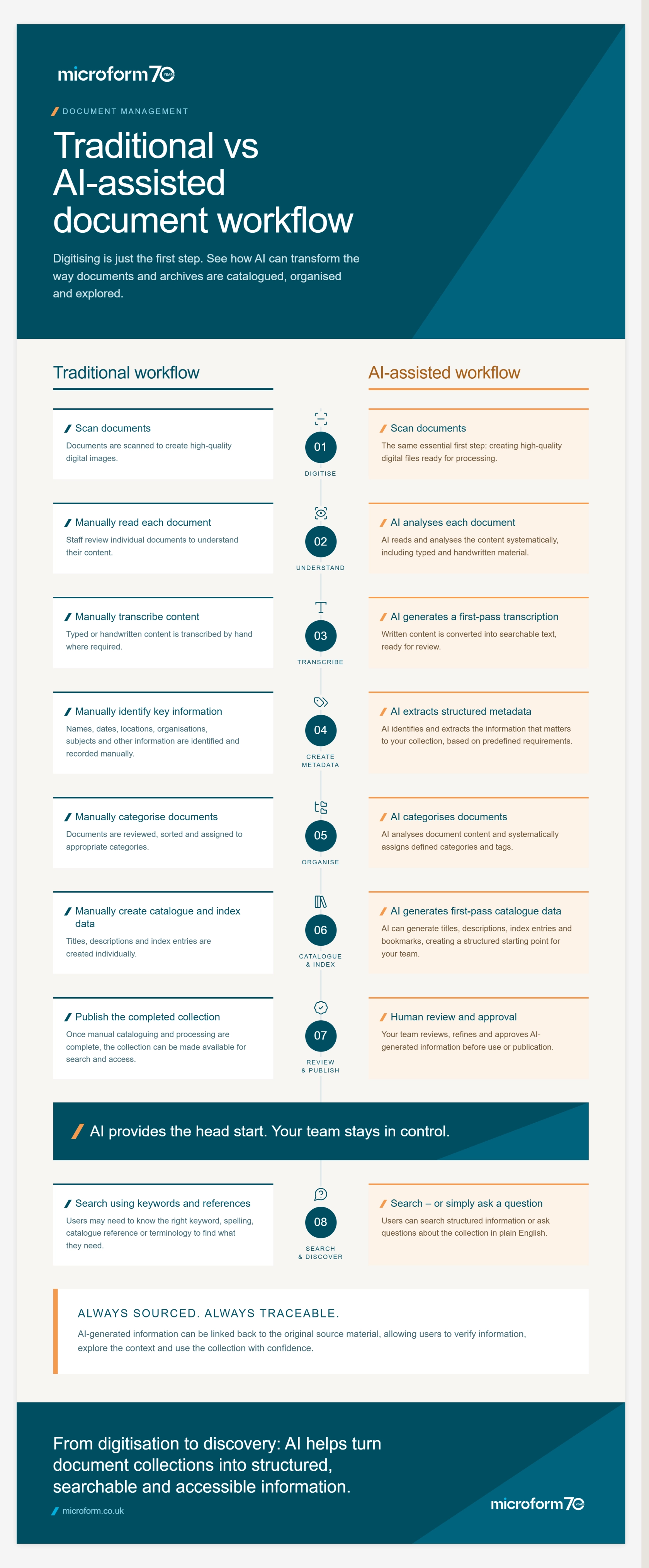
Traditional vs. AI-assisted Document Workflow - Infographic
Digitising a collection has always been step one, not the finish line. Once documents are scanned, someone still has to read them, transcribe them, work out what they're about, and organise them so people can actually find what they need. Traditionally, that's been a slow, manual process, and often the biggest bottleneck in any archive or document management project.
AI is changing that. Rather than replacing the digitisation process, it accelerates everything that comes after it: reading and analysing content, generating first-pass transcriptions, extracting key metadata, and suggesting categories and catalogue data. What used to take a team weeks can now be drafted in a fraction of the time, with your team reviewing and approving the results rather than creating them from scratch.
The infographic below compares the traditional, manual workflow with an AI-assisted one, step by step, from scanning through to search and discovery. The essentials don't change: documents still need to be digitised, understood, catalogued and made accessible. What changes is how much of that heavy lifting AI can take on, while your team stays firmly in control of what gets published.
And however the catalogue data is generated, it always stays linked back to the original source material, so anyone using the collection can verify information, explore the context, and search with confidence.